Dreamforce is not a conference. It is a city that assembles itself for three days and then disappears — forty-five thousand people, every industry, companies that measure revenue in billions standing in the same hall as companies that measure it in clinics.
Underneath all of it, one question. Smaller than the venue. How do you give an agent enough context to be trusted with something that matters?
MIMIT Health and CIMSS did not come to Dreamforce to ask that question. We came with five months of answers.
The headline was written in April
On April 20, 2026, Salesforce published a customer story. The title was not ours to choose:
“MIMIT Health creates a trusted system of context for every patient.”
Not a concept. Not a roadmap item. A published account of a specialty care organization that had already replaced its EHR as the center of gravity with Agentforce Health, and already grounded every workflow in Data 360.
Five months later, context was the theme on the main stage.
Why context is the hard part
An agent trained on the corpus of medicine knows what a diagnosis is. It does not know what this diagnosis means inside this organization — which system holds the imaging, which note the surgeon actually reads, what “pre-op clearance” means in a practice that averages five procedures a day per physician.
Ask it anyway and it will answer. Confidently. Wrongly.
That gap has a name in our work. Intelligence processes information. Knowledge accumulates it. Context tells an agent which information belongs to this patient, in this practice, at this moment — and where to go find it.
Without context, an agent guesses. With context, it behaves.
What it took
The architecture is not a single product. It is a chain, and every link is load-bearing:
- Agentforce Health — the center of gravity for the business, in place of a traditional EHR.
- Data 360 — the trusted context behind every workflow.
- Informatica — cleans, aggregates and catalogs data before it lands, reconciling duplicate identities into one golden record per patient.
- Zero-copy architecture — millions of structured and unstructured records flow in from Snowflake without duplication.
- MuleSoft and Intelligent Data Processing — scanned PDFs, insurance cards, referrals and intake documents parsed and mapped to the correct patient profile.
- Slack — where the care team and the agents meet. Every patient has a private channel.
- Salesforce Shield and a healthcare-specific data model — HIPAA, HL7 FHIR, HITRUST, FedRAMP. Compliance as a floor, not a feature.
Implemented by CIMSS.
What it bought
Within three months: a 459% return on investment. $500,000 off system maintenance. Inventory expense down 15%. Roughly $1.5 million in annual savings.
Those are the numbers a CFO reads. These are the ones that matter more.
Physician burnout at MIMIT Health is in the low single digits, in an industry where nearly half of physicians report it. Providers see 40% more patients. Employees get back three hours a day.
“We’re responsible for people’s lives. They’ve given us their trust. We have to make decisions using trusted data in the right context. And that’s where Salesforce helps.”
— Dr. Paramjit Chopra, MIMIT Health
Implemented by CIMSS.
What Dreamforce showed us
Patrick Stokes, President of Applications and Marketing, quoted Parker Harris — Salesforce co-founder and advisor to the CEO — from the stage:
“Why should I ever log into Salesforce?”
The answer: you shouldn’t. You’ll work through Slack.
The room reacted the way rooms react to a good provocation. Our founder, a practicing interventional radiologist who averages five surgeries a day, has not logged into Salesforce in five months. He works in Slack. He asks for a summary of a patient’s history, it arrives, and the care team sees it at the same moment he does.
Controversial to many. Everyday work to us.
Later, Stokes demonstrated a new Salesforce plugin for Claude and did something keynotes rarely do. He listed the reasons it was hard.
“Who’s heard of MCP servers here? Who knows what MCP servers are and how to use them? A lot of hands are going to go down… Who knows how to enable zero data retention? Not many people. Who’s written skills for Claude?… This is hard stuff.”
— Patrick Stokes, President of Applications and Marketing, Salesforce
It is hard stuff.
It is also in production across our organization, used daily, by people who do not think of themselves as technologists. MCP servers. Zero data retention. Skills. Not a proof of concept in a sandbox — the way the work gets done.
Watching a room full of hands go down on capabilities our staff stopped finding remarkable is a clarifying experience.
Boots on the ground
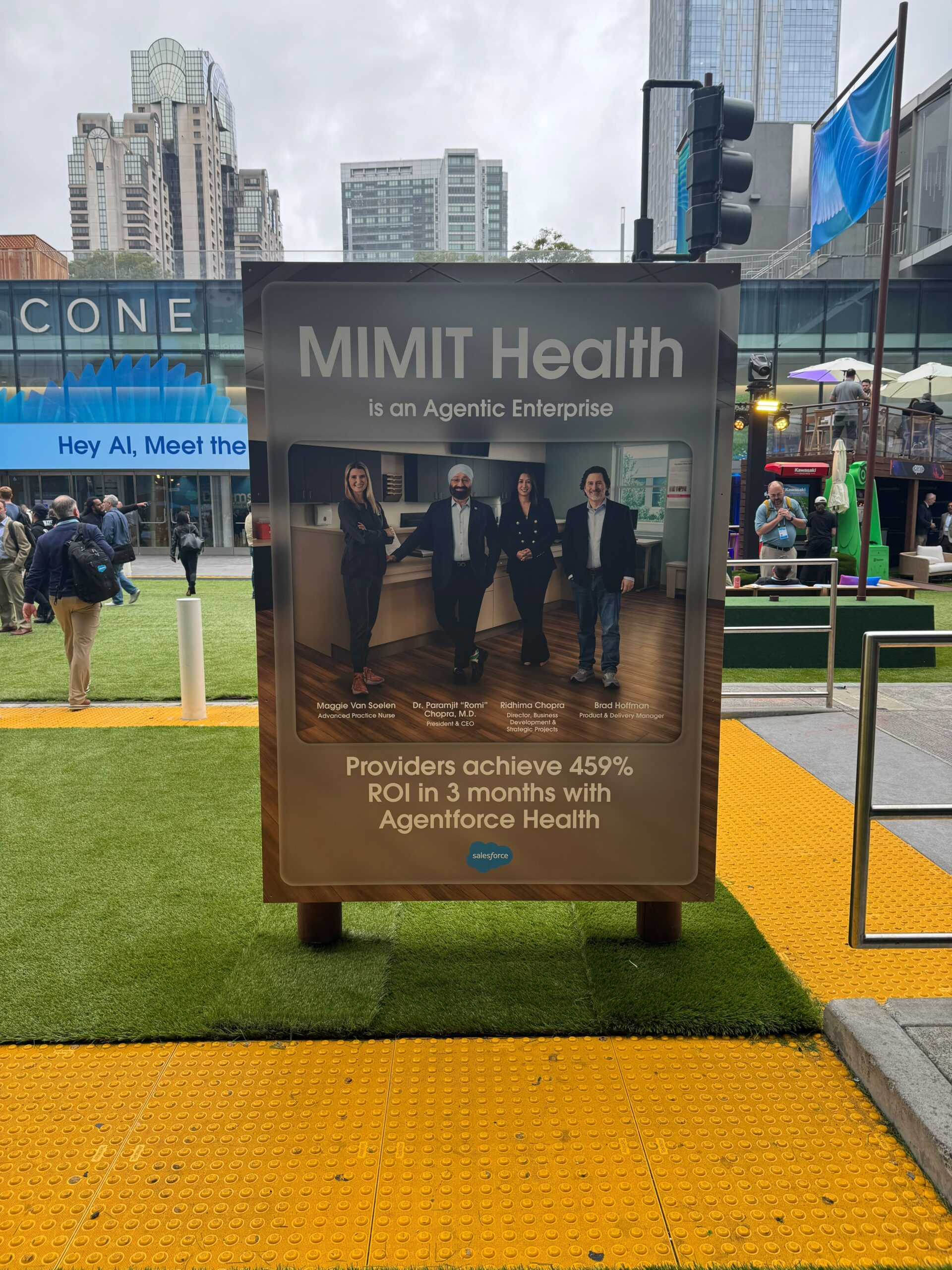
Outside the conference centers, as forty-five thousand people filed toward the keynote halls, the screens carried provider imagery from our shoot earlier this year.
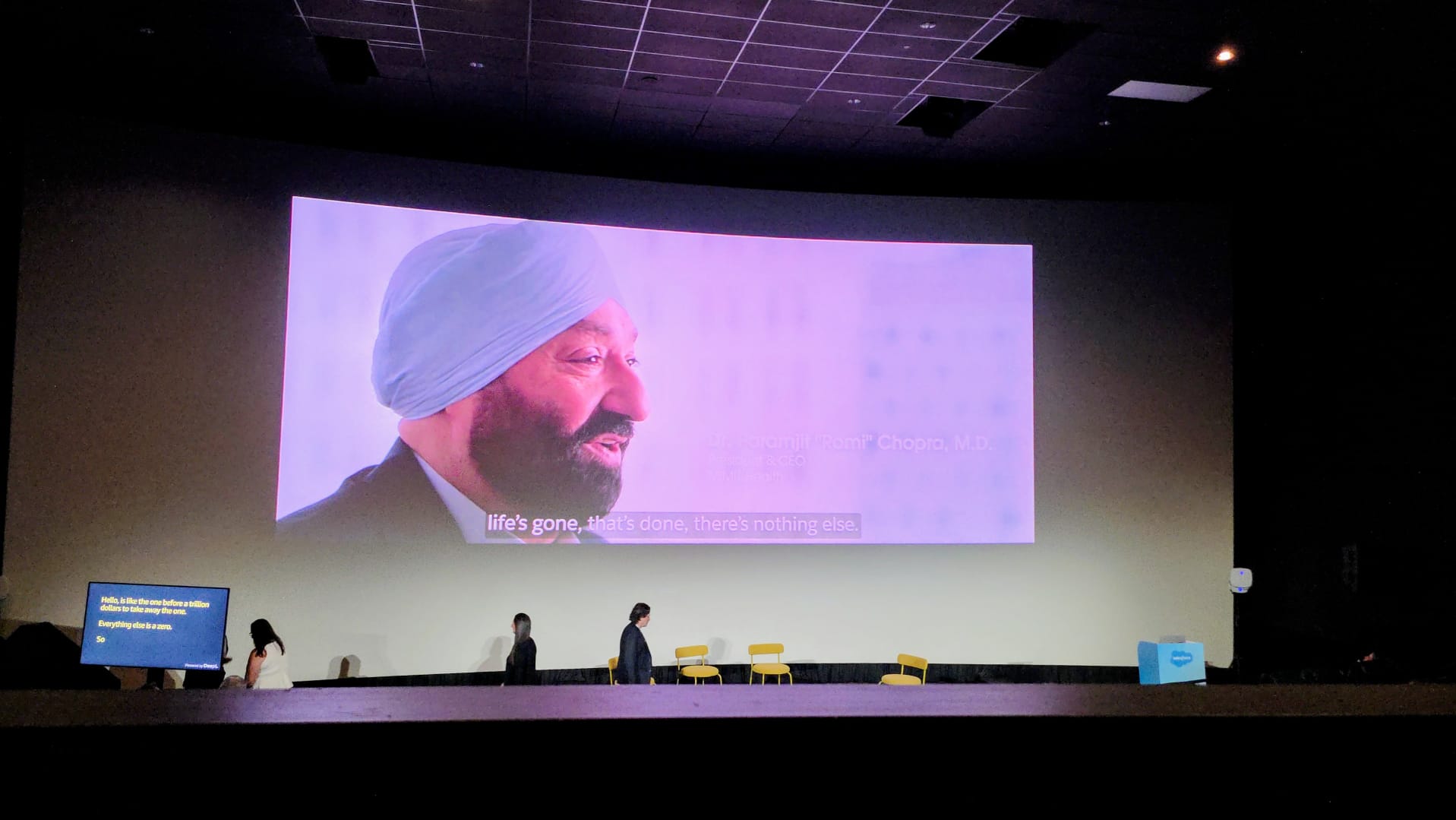
Inside, Dr. Chopra’s comments ran on the big screen. So did a clip of Brad Hoffman describing what happens when a provider stops hunting for information: preparation time down from 90 minutes to 90 seconds.
During the Health keynote, Lizanne Keel, Executive Vice President for Healthcare at Salesforce, named MIMIT Health from the stage.
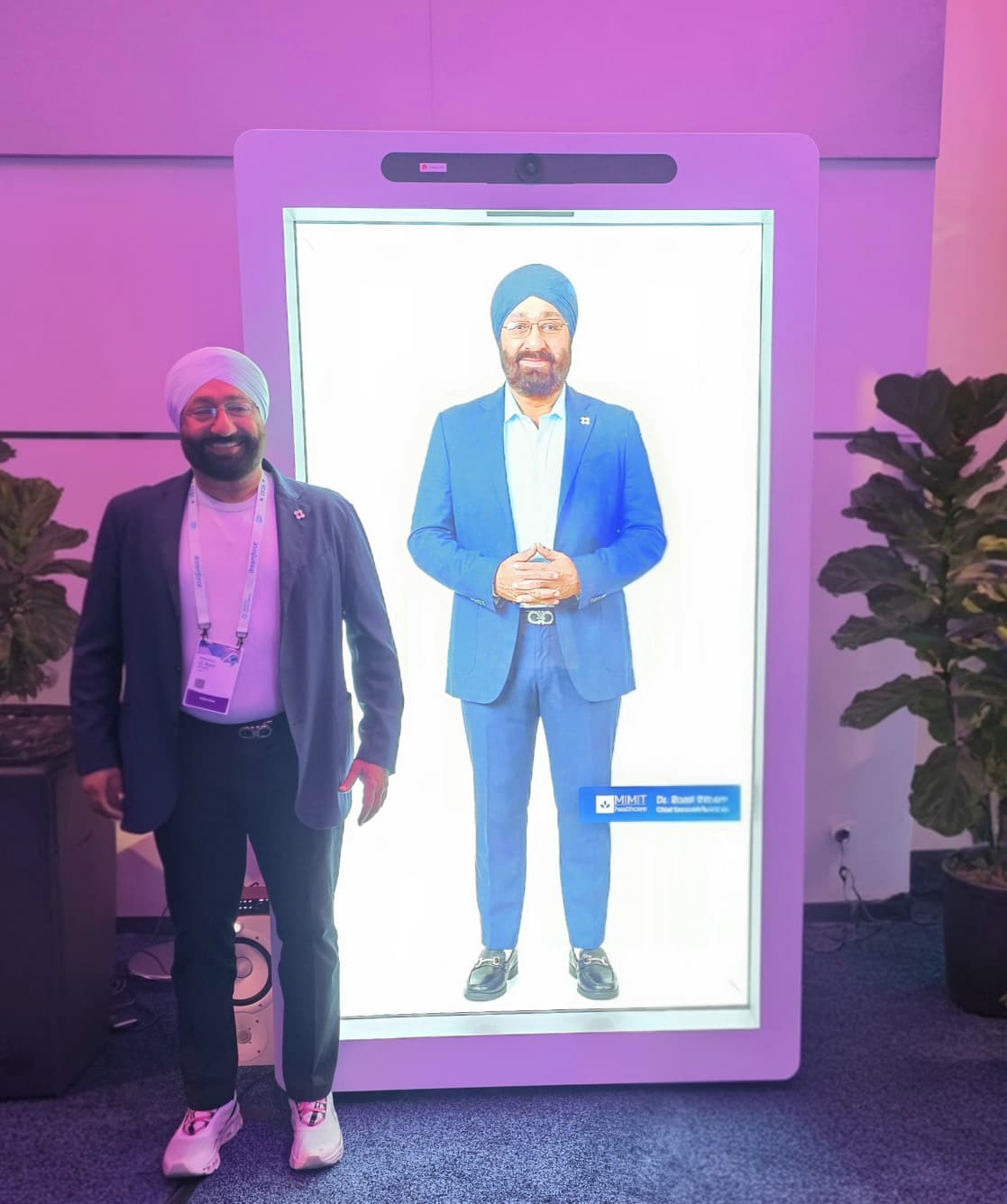
And in the executive summit rooms, there was a life-size Dr. Chopra you could talk to.
It carried his likeness and his voice. It was trained on years of the content he has produced — writings, presentations, a career of thinking out loud — fed into Data 360, so that a question put to it returned a response drawn from what he has actually said.
Not what a general model would guess a physician might say. What this physician has said.
Which is the entire thesis, standing in a hallway, answering questions from strangers.
Why this matters
CIMSS and MIMIT Health are small. Next to the global consulting firms in that hall, we are a rounding error.
We were on the screens anyway.
Not because of scale. Because a practicing interventional radiologist and the team that builds his systems can see a new capability on Tuesday and have it in front of a provider by the following week. Large firms bring methodology. We bring a clinic, a surgeon, and a deployment.
Salesforce did not feature us as a customer. They featured us as evidence.
The city disappears
By Friday the hall was empty. The screens were dark. The avatar was packed into a crate.
And on Monday morning in Chicago, a physician opened a patient profile and saw everything he needed already in front of him — history, recent visits, upcoming procedures, notes from the whole care team. No hunting. No stitching. No going home to finish documentation.
The conference was a preview. That was the product.
Medicine at the speed of life.
CIMSS Innovative Solutions builds intelligent healthcare operating systems on the Salesforce platform. Visit cimss.com.