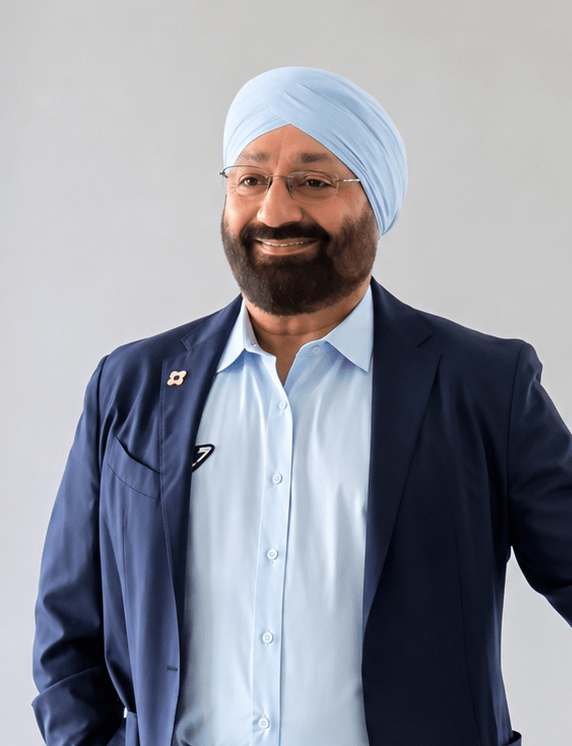
The patient is one person. The data about them is scattered. I have spent thirty-five years on both sides of that sentence — and it turned me from a physician into something I had no name for until recently.
The patient on the angiography table has always been whole — one circulatory system, one history, one set of fears. But the data about that same person has always been in pieces: the EHR, the PACS, the lab system, the billing platform, the referring physician’s notes, the device rep’s spreadsheet. For most of my career, I could see the entire patient clinically and only ever see fragments of them in data.
Closing that gap became the problem I could not leave alone. It turned me, slowly, into something I had no name for until recently: a Physician-Architect.
Catheter to Cloud
How a clinician became a builder
I am an interventional radiologist by training. I was an early adopter of the electronic medical record at Brigham and Women’s Hospital in 1990, when EMRs were research curiosities used by almost no one in private practice. By 2006, I was running a multi-hospital imaging network with a single goal written across the top of the plan: any image, anytime, anywhere, by anybody. I did not realize it then, but that sentence was the seed of everything I would build for the next twenty years.
I came to data the way physicians come to most things — a problem at the bedside I could not stand to leave unsolved. I was not trained as a data scientist or an MBA. I learned the way you learn a procedure: by doing it, getting it wrong, and refining it until it is repeatable. I studied data architecture from first principles. I drew the database-connection stack by hand before I trusted anyone to build my pipeline. I paid real money for experiments that failed — tuition, not waste. The catheter and the cloud, it turned out, were the same instrument pointed at the same target.
Treating Healthcare as a Patient
A method, not a metaphor
Somewhere around 2013, I wrote a line I still believe is the most important sentence in everything I have done:
“Very similar to how we practice medicine — treating the entire health care system as a patient. How do we keep it healthy?”
That is not a metaphor. It is a method. You diagnose before you intervene. You measure before and after. You monitor, and you adjust. A health system, like a patient, has a history, comorbidities, and failure modes. Treat it like one, and the work organizes itself: find the data, make it trustworthy, put it to work at the moment of decision, and watch the outcome move.
The EHR Was Never the Destination
The difference between data and intelligence is activation
The mistake our industry made was treating the EHR as the finish line. It is a starting point. Data sitting still does nothing. It has to be activated — unified, governed, and delivered to the right person at the right moment.
The largest technology platforms are now converging on this, assembling agentic systems in layers — data, orchestration, agents, content, engagement. But there is one layer none of them can sell you. Between the data and the agent sits meaning: what counts as an active patient, a high-risk limb, a true no-show. A machine cannot reason clinically until a clinician tells it what the words mean. That layer — the physician-curated clinical ontology — is the one thing a platform vendor cannot ship in a box. It has to be built by someone who has stood at the table.
That is what a Physician-Architect is. Not a doctor who bought software. A clinician who encodes judgment into the system itself.
One Unbroken Thread
Thirty-five years, one conviction, deepening language
1990
Early EMR adopter at Brigham and Women’s Hospital
2006
“Any image, anytime, anywhere, by anybody”
2013
“Treat the entire health care system as a patient”
2018
“The right information, to the right people, at the right time”
2023
“Find data’s path to value”
2026
“The physician-curated ontology is the moat”
The same conviction, restated across three decades — from the angiography suite to the operating system.
From Records to Evidence
Where the field is going
Here is where I believe the field is going, and it is the part that should interest every device maker, researcher, and clinician in my specialty. Once clinical data is structured and trustworthy, it stops being a record and becomes evidence. It begins to answer the questions that matter: which therapy works in which patient, where outcomes truly concentrate, and whether the metric actually moved.
In a field like mine — vascular, device-intensive, where a limb is saved or lost by decisions made years upstream — that shift from record to evidence is not a convenience. It is the difference between guessing and knowing. The infrastructure to produce that evidence at scale, governed and physician-curated, is no longer theoretical. It is running.
The Discipline Stays Clinical
A profit center only if it is first a trust center
A caution I hold close: the moment you treat data as an asset, you owe the patient more, not less. Everything worth building here is governed — de-identified where it must be, consented where it should be, auditable always. Data becomes a profit center only if it is first a trust center. A Physician-Architect who forgets that is just an engineer who happens to have a license.
I did not set out to build a company. I set out to keep my patients’ information from being lost. Thirty-five years later, the goal has not changed at all: the right information, to the right people, at the right time, to make the right decision. That is the whole of it.
The rest is architecture.
Build healthcare like you mean it.
CIMSS Innovative Solutions builds the Intelligent Healthcare Operating System on the Salesforce core — proven in production at MIMIT Health before it is ever offered to a client. If you are ready to treat your data as evidence, let’s talk.